Showing posts with label George Haloulakos. Show all posts

Friday, December 31, 2021

Remembering the Way We Were - Reflections on Childhood and Coming of Age as Baby Boomers

by George Haloulakos

Baby Boomers (i.e., those born between 1946 to 1964) from all parts of our nation and all walks or stations in life have a remarkable degree of similarity of shared experiences associated with childhood and/or coming of age.  This is not mere nostalgia but rather a reflection of a confluence of several major factors or variables that profoundly shaped the lives of those born in the aforementioned period.  In 2015, Robert D. Putnam published a book titled Our Kids: The American Dream in Crisis.  As the Baby Boomer generation transitions into retirement, this is a very important read that enables one to understand the uniqueness of shared experiences that may seem quaint or outdated but are of vital importance in understanding where we have been, where we are now and where we may have gone off the rails.

    A good many GNN followers are familiar with such childhood reminiscences as playing ball in the streets as well as the front and back yards in the neighborhood, riding bikes everywhere, staying out all day in summertime and not checking in with parents until dinnertime, drinking water out of a garden hose, and so forth.  There were no "play dates" or "gated communities."  People knew their neighbors along with their children.  Factory workers, shop keepers, office workers, local government officials, teachers, public servants such as police officers, firefighters and so forth all lived on the same block.  On the same block residents included high-income earners as well as those of more modest means.  The only outward signs of wealth were either an extra car in the driveway, recreational vehicles (e.g., camper or speedboat), being the first in the neighborhood to have a color TV set or perhaps a swimming pool.  Less visible but also significant signs of affluence were having a cabin or weekend getaway locale and perhaps a country club membership.  All children, regardless of their economic status, attended the same schools and participated in the same extra curricular activities.  Kids from all backgrounds found a relatively level playing field in the classroom as well as in the context of extra curricular activities (artistic or athletic).
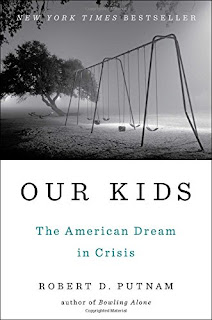
    Mr. Putnam's book, Our Kids, is a real page turner as he demonstrates the similarity of childhood experiences across different regions of the USA in which neighborhoods were far more representative of the population at large than today.  Our Kids, does not so much as provide ready-made answers as it does in asking the right questions that helps to explain the way we were!  It would seem that the key factors accounting for the unique shared experiences we find relatable as baby boomers is the confluence of economics (specifically a deeper, more well established manufacturing base greatly augmented by the 1960s Space Age), parenting and/or mentoring, family structure and supportive institutions (e.g., churches, schools, parks & recreation, libraries).  While there are supporting statistics to document the author's observations, the book really shines when it focuses on the poignant real-life stories of people who grew up as baby boomers and those that followed.


    As I read Our Kids, I was reminded about the importance of parenting as well as economics, especially in relation to education.  In the greater Los Angeles area, for example, the difference in cost for a college education (think USC vs UCLA as a microcosm of private vs public institutions) was not so much a consequence of where your parents were on the economic ladder, but rather how the economy of that period provided greater choices for one and all.  In my own experience, the kids who ended up attending USC rather than UCLA had more to do with how parents prioritized their personal spending, especially if you were a first-generation American (i.e., child of immigrant parents).  Those parents chose to forgo having the latest model car or other amenities, did not own a weekend get-away residence, did not belong to the country club and often lived in a more modest, less ostentatious home in order for their children to pursue higher education.  Those kids who were on scholarship (including athletics or sports) either at private or public institutions had parents who were more interested in what went on in the classroom than on the ball field.  

    A good example was UCLA's Gary Beban (whose parents were of Croatian and Italian heritage), the university's only Heisman Trophy Winner (1967) who noted in multiple interviews that his mother and father ALWAYS expressed interest in how he was progressing with his studies but cared less about his athletic exploits (though taking pride he excelled at both by also achieving status as an Academic All-American to accompany his Heisman Trophy).  Mr Beban, who graduated on time with a Bachelor's degree in European History, himself stated he was at UCLA for the scholarship and to pursue higher education.
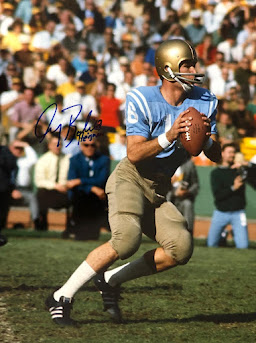
Mr Beban's experience reminds many of us that we were greatly blessed to have grown up in a two-parent household in which a stay-at-home mom complemented the father who worked full time to provide for the family.  There were teachers who went the extra mile in offering tutoring or special tips to how parents could work with their kids on improving their basic skills in reading, writing and mathematics so they would not be left behind. Clearly it was a very different time and place in our nation's history.  I could go on, but you get the idea of the subtle but critical interplay of economics, parenting/mentoring, family structure and supportive institutions that has shaped the common experiences we recall as baby boomers.  


   Our Kids, by Robert D. Putnam, is clearly an important book and worth sharing with others to document that our shared memories are not the by-product of nostalgia but very real and life affirming.

    Have any of you read this book, and if so, what are your impressions?  What special experiences did you have that perhaps may not be relatable to the present generation but help to define who you are?  Please share your thoughts by posting to the Galaxy FACEBOOK page @galaxynostalgianetwork,  (and please remember to "like" us when doing so) or via e-mail to the GNN web site.

If you would like, please connect with me via LinkedIn (where my active following is now 1,100+ and steadily growing).  View my profile at:  https://www.linkedin.com/in/rev-protodn-george-haloulakos-cfa-bab6b43

Monday, October 4, 2021

"CROCODILE" DUNDEE - 35th Anniversary: "G'Day Mate!"

by George Haloulakos

With this familiar greeting, this month's GNN Blog takes this opportunity to celebrate the 35th Anniversary of "Crocodile" Dundee.  Released in 1986, this action comedy featured Paul Hogan in the lead as the rugged outdoorsman Michael J. "Crocodile" Dundee (aka "Mick") with Linda Kozlowski as newspaper journalist Sue Charlton, his romantic interest.  The film begins in Australia where we bear witness to Mick's physical prowess in the Australian Outback and the burgeoning romance with Sue, a newspaper journalist who is there to write a lengthy feature on "Crocodile" Dundee for her employer.  It then shifts to New York City as the newspaper (owned by Sue's father) decides to bring Mick for an all expense-paid visit to the USA as a pretext for continuing the feature story.  

   While in Australia, Mick is clearly in his element having fun with his mates while escorting Sue deep into the Outback providing physical evidence for his legendary exploits that are to be profiled in Sue's feature article.  When the scene shifts to New York City, the film becomes a comedy of manners as Mick deals with various situations while somewhat bemused by American big city customs and behavior.  Among just a few of the social situations that our hero deals with, while delivering some memorable lines:


An attempted robbery is broken up when Mick responds to his attacker -- that is brandishing a switchblade (as Sue cautions Mick to be careful because the assailant has a knife) -- by pulling out his very own outsized "Jim Bowie" hunting knife while laughingly declaring "that's not a knife, THIS is a knife" and then swiftly dissuading the would be muggers from further engagement while noting they are just kids having fun! 


   Our hero tells a New York driver to "get on the right side of the road you pelican!" Mick concludes the reason there are so many car accidents in the US is that the steering wheel is on the wrong side of theThere is much more, especially when Mick attends various social gatherings.  But this small sample reflects the "fish out of water" theme as the film audience connects with the man who has ventured from the Australian Outback into a very different kind of jungle, New York City (aka The Big Apple).  Mick is able to skillfully navigate the urban jungle while making friends, winning the admiration of the public and maintaining his integrity while exercising common sense.  He is a person who shows himself to be attractive to both men and women with a carefree, devil-may-care approach to life.

   Vintage film buffs will note that in some ways "Crocodile" Dundee is a 1980s variant of the 1942 MGM classic "Tarzan's New York Adventure" that starred Johnny Weismuller.  Both of our heroes remain quietly but firmly self-confident as they try to make sense of big city behavior and civilization.  When circumstances require bravery and integrity, both Tarzan and Mick are able to come to the rescue.  It is a theme that transcends time while successfully being able to poke fun at prevailing social customs of the day!

  The financial success of "Crocodile" Dundee (it earned over $328 million in worldwide box office receipts) led to two sequels -- "Crocodile" Dundee II (1988) and "Crocodile" Dundee in Los Angeles (2001).  

   One of my favorite lines came from the Los Angeles sequel.  Early in the film the audience -- along with Mick -- sees actor George Hamilton playing himself in a cameo appearance at a Hollywood party where he is extolling the virtues of coffee enemas.  Later in the film when Mick is hosting a fellow Outback survivalist named Jacko who is visiting LA, the two outdoorsmen are seen walking along Hollywood Boulevard passing by a local gourmet coffee outlet.  When Jacko suggests they have coffee, Mick (recalling his earlier encounter with George Hamilton) tells his friend "Oh no, mate.  You do not want to have coffee the way they do here!"

Part of the enduring fun is seeing Mick handle all the different challenges - be it through physical prowess, common sense, humor and the cleverness we associate with survivalists - while having the respect and love of Sue as well as the deep friendship with his mates from the Australian Outback.  It's a winning formula that still holds true more than 35 years later!

If you have special memories of our favorite Australian Outback survivalist that you would like to share, please post to the Galaxy FACEBOOK page (and be sure to "like" us when doing so) or via e-mail to the GNN web site..  Please connect with me via LinkedIn (where my active following is now 1,100+ and steadily growing).  View my profile at: https://www.linkedin.com/in/rev-protodn-george-haloulakos-cfa-bab6b43

Saturday, November 2, 2019

NFL Centennial

by George Haloulakos
This year marks the centennial anniversary of the National Football League (NFL) and we celebrate this great event through the prism of the amazing 21-year career of quarterback Earl Morrall (1934-2014).  Morrall is an NFL legend as indicated by his different monikers: King of the Comebacks, the Best of the Back-Ups and the Champion of the Understudy.   Any one who has played football at any level or in any venue knows the importance of the quarterback (QB) position, and can relate to the enormous competition to be the signal caller.  Morrall exemplified the preparation and commitment to excellence we all strive for, especially in sports.  By his own words he said that "when you get the chance to do the job, you have to do the job."  Morrall showed why it was prudent to be prepared at a moment's notice for such an opportunity.


Morrall elevated the importance of the understudy, and much more.  During the first twelve years of his NFL career he was a backup QB for the San Francisco 49ers, Pittsburgh Steelers, Detroit Lions and New York Giants.  In an era of legendary NFL QBs (Bobby Layne, Norm Van Brocklin, Y.A. Tittle, Johnny Unitas, Bart Starr, et al) Morrall showed himself to be a competent, efficient professional always ready to take the helm when needed if the number one signal caller was unable to play.  When Morrall joined the Baltimore Colts, his legend unfolded.  Taking over for an injured Johnny Unitas in 1968, Morrall led the Colts to an NFL Championship while earning MVP and All-Pro honors.  Two years later, he again came off the bench to replace an injured Unitas, this time in Super Bowl V, to lead the Colts to a last second victory thereby winning the World Championship!  Two years later, this time with the Miami Dolphins, Morrall took over as the QB from the injured Bob Griese and helped lead the Dolphins to an undefeated season plus win a playoff game.  While Griese returned as the starter for the AFC Title and Super Bowl games to cap the Dolphins' first World Championship, Morrall continued to work closely with head coach Don Shula (who was his former coach while playing for the Colts) in what can best be described as an informal but active player/coach role.  Having Morrall available to immediately step into the QB role enabled the Dolphins to not only achieve the only perfect season in NFL history, but go on to repeat as back-to-back Super Bowl champs the very next season!   Following his NFL career, Morrall mentored legendary collegiate QBs Jim Kelly, Bernie Kosar and Vinny Testaverde at the University of Miami thereby passing along the art of quarterbacking to a new generation.

Ironically, in this the 100th year of the NFL, there has been a rash of injuries to a rather large number of star QBs, thereby again elevating the importance of having a good substitute in the wings.  It would seem that NFL teams are all now eagerly searching for this generation's Earl Morrall just in case the situation requires an effective substitute to step in.  Earl Morrall showed what it means to be a leader and a great team player.  Don Shula described Morrall as an "intelligent quarterback who's won a lot of ball games for me."  There have been a lot of NFL QBs who are heroes of the game.  While heroes get remembered, legends never die.  Earl Morrall was a legend, and now almost 50 years since his stellar gridiron accomplishments, we salute this Galaxy Good Guy as one of the best to ever play the game, albeit in a back-up role!

Please join us in celebrating the centennial anniversary of the National Football League by sharing your favorite NFL football memories with us by posting to the Galaxy FACEBOOK page (and be sure to "like" us when doing so) or via e-mail to the GNN web site.  Likewise, I am always receptive to hearing from our wonderful Galaxy audience and/or connecting via LinkedIn.
View my LinkedIn profile at: https://www.linkedin.com/in/rev-protodn-george-haloulakos-cfa-bab6b43  

Wednesday, March 7, 2012

Baseball Memories (Program 79)

Baseball, the great American pastime! George Haloulakos helps us to remember the days gone by of baseball, particularly while he was growing up in the 60s. George and his father have written a fantastic treatise on baseball history during this time period. We remember two celebrated players of the past: Don Drysdale and Sandy Koufax. We recall the excitement and wonder of going to baseball games back in the early 60s. The wonderful players who were professionals on the field, and true gentlemen with their many fans. This was a different time in the world of baseball, and we recall those days. Pictured above, the great Don Drysdale and Sandy Koufax.

George Haloulakos writes:

This program was inspired by an article written by George and his father, Dr. V.E. Haloulakos, that is dedicated to the blessed memory of Don Drysdale - who taught a whole generation of us kids on how to play to win and forever remains a touchstone in my dad's journey to becoming an American citizen, and to Sandy Koufax - who put God before the World Series, team above self, and integrity above fame.

Thursday, March 1, 2012

Maggie, the Galaxy Moonbeam Night Site Mascot.


We're pleased to introduce you to Maggie. She is the official mascot of Galaxy Moonbeam Night Site. Maggie is owned by our very own George Haloulakos and his wife, Sharon.

Maggie herself writes: San Diego is known for being the most dog-friendly city in the USA, and Galaxy Moonbeam Night Site is such a dog-gone-good show! I faithfully listen to Galaxy Moonbeam Night Site. I know the voices of Mike B, Smitty, Mike Z, and of course my dad George. And I find them very soothing. Ricky Nelson is my favorite recording artist and I have my very own collection of Ricky Nelson CDs to help me relax and fall asleep.

George writes: I also included photographs of Maggie doing her Therapy Dog work at Le Bleu Chateau (the assisted living facility where my mother now resides in Burbank). The
owners and operators of the Le Bleu Chateau wrote the following about Maggie. It shows that her love and caring exemplify the values of Galaxy Moonbeam Night Site: "We are very fortunate to have Caregiver Maggie on duty. Maggie does not have a specific role at Le Bleu, but she instinctively knows how to care. She is great at cheering up a room, reminds seniors they are
loved, and encourages mobility and flexibility by requesting that residents pet
her. Maggie has earned her title as our Therapy Dog".

We are pleased to have Maggie on board as part of the Galaxy Family.


Monday, November 21, 2011

Baseball History from George Haloulakos

Hello Baseball fans --
My new article on the legendary pitcher Sal Maglie (aka "The Barber") has just been published.
Enjoy!

Click Here:

George

Tuesday, October 25, 2011

Man, Moon, Media, and Myth (Podcast 69)

We welcome George Haloulakos, who along with his father, Vassilios E. Haloulakos have authored a fascinating thesis titled "The Science of Space Flight in Classic Sci-Fi Cinema". George relates the technology of space flight that is portrayed in two classic productions: the 1964 unaired pilot episode of "Lost in Space" titled "No Place to Hide", and the 1968 motion picture "Planet of the Apes". How realistic were the space craft and technologies that were shown? Find out by listening in. In addition, we remember that era of the 1960s when the goal to land a man on the moon was at its peak. It was a positive, productive era when the nation joined in the hope that this goal would be reached, and that the dream of President John F. Kennedy would be fulfilled before the end of the decade. Photo courtesy of George Haloulakos, from his personal collection. Please go to our Facebook page to see additional items from George's collection in the "Man, Moon, Media, and Myth" photo album.