Friday, January 5, 2024

 JANUARY 2024


- See You at the World's Fair! -
By Rev Protodeacon George A. Haloulakos

For Baby Boomers whose school years Grades K through 12 spanned the 1960s, it felt like a decade chock full of World's Fairs. Most notably were Seattle 1962, New York City 1964, Montreal (Canada) 1967 and HemisFair - San Antonio 1968.  Since the mid-19th century, there have been large global exhibitions (termed world's fair or fun exhibition or expo) for showcasing the achievements of nations.  The theme for these exhibitions have changed over the years and can be described as spanning three eras: Industrialization (1851-1938), Cultural Exchange (1939-1987) and Nation Branding (1988 to present).


These exhibitions have been held in various parts of the world at a specific site for various periods of time, but typically ranging three to six months in length.  They not only reflect the eras in which the exhibitions were staged but in many cases, convey a positive, optimistic vision of the future based on extrapolation of the technology and demographic trends of the day.

As television and jet air travel became pervasive during the 1960s, the World's Fair became a topic of serious conversation for people of all ages.  In fact, with the mass-market My Weekly Reader publication distributed nationwide to both private and public schools (Grades K through 12), school children were able to converse intelligently with their elders at mealtimes as this iconic newspaper for young people provided in-depth coverage on the World's Fair exhibitions that were on the North American continent.  Not only did these events stimulate family conversation, but also provided the impetus for special summer vacation outings or family trips while being celebrated with the issuance of commemorative postage stamps.  These commemorative stamps from the four World's Fair exhibitions mentioned in this article are shown here and have become Baby Boomer collectibles.


The 1960s World's Fair exhibitions so widely remembered by Baby Boomers are associated with major landmarks that remain standing to this day and are emblematic of special moments in time.  The Space Needle and Seattle Center Monorail (1962), the Unisphere in New York City (1964), the Montreal Biosphere (1967) and the Tower of the Americas and San Antonio Convention Center (1968) celebrate the theme of Cultural Exchange while extolling a positive outlook for the future.  World's Fair landmarks that remain standing and becoming famous are not new.  It actually started with the Eiffel Tower built in Paris for Exposition Universelle (1889) and the aforementioned North American landmarks have continued this tradition.  Notably, the Space Needle and Tower of the Americas are American variants of the Eiffel Tower.


Yours truly has fond memories of the World's Fair landmarks in Paris, Seattle, New York and especially San Antonio as I was able to personally attend HemisFair 1968.  What are your recollections of these special events?  Were you able to attend them in person or visit them later during their afterlife?  We invite you to share these memories by posting to the GNN FACEBOOK page (and "liking" us when doing so) or send them to us via the GNN g-mail address.  We wish all of you a Happy New Year! 

Saturday, December 30, 2023

"Let’s Teach Margaret to Sew"

by Margaret Sizemore Clark

In my youth I was what I would consider to be a tomboy. I grew up playing with my older brother’s Matchbox cars. One year for my birthday I received a “huge” Pontiac station wagon car, not a model of one, but a scaled-down version of the real thing, just right for transporting a Barbie, but she hadn’t been invented yet!  I was delighted!!  I rather enjoyed doing “car” things with my father, and I liked playing in the dirt after a rare rain. 

    In those days girls were taught all the necessary skills to be a good homemaker, hostess, wife, and mother.  Sewing was one of the skills to that end, and being accomplished using a sewing machine was something that my family did well. My mother made matching outfits for me and the sister just a year younger than I, along with the sister that was eight years after her.  We frequently received lots of comments about the cute matching dresses or shorts sets when we went places.  Additionally, at least two of my sisters learned to sew when they were Girl Scouts.  My oldest sister was making her own clothes in high school and became very skilled at it. I was never a Girl Scout. The pressure to conform to “the norm” was mounting, but I resisted.  To her credit, Mom kept trying to encourage me to sew but eventually she realized that it wasn’t a good idea to try to force me to learn, and apparently the sewing gene had skipped me, so I dodged that bullet. But in junior high it came up AGAIN: one of my best friends was in 4H and was making her clothes, as were most of my friends. It was pointed out what beautiful, fashionable clothes they were creating, but I wasn’t taking the bait.  The last assault on my refusal to learn to sew came when my older sister needed a babysitter for the summer while she and her husband worked. I was invited to come to Oregon to live with their family.  Little did I suspect that it was to be another attempt to teach me to sew, and I was trapped!  My sister patiently tried yet again to teach me how to sew, and I tried, I really did! I think I made something fairly simple, using straight seams, but when it was done, so was I.


    Years later my oldest sister retired to Sisters, Oregon. Now, if you or a loved one are into quilting, you know that Sisters has an outdoor quilt show every July, and the quiet, sleepy little town with about 1500 citizens swells to ten times that much.  Women come from all over to take classes, make quilts, compare projects, and see what others have created during the year since they last came to Sisters. My younger sister and two of her friends were teachers, so they were able to make the pilgrimage to “Mecca”, aka Sisters, every summer, a week ahead of the quilt show.  During that week they fed their addiction for buying fabric, sewed, taught each other new techniques, and showed off new machines. I was a teacher too, but at a year-round school, so I couldn’t come with them.  Eventually I was able to transfer to the track that was closest to the traditional school year, so I was invited to join them, BUT: I was warned that since I didn’t sew, I would have to bring some other type of hobby that would keep me occupied, or else I would have to be “Cinderella” and wait on the others.  I complied.  I didn’t want to miss out on the shopping trips, the gabbing, and seeing the amazing things they created so I became “The Husband”.  

    Husbands are the patient angels that come with their wives during Quilt Show week.  They are so legendary, that wise quilt store owners have created a special place for them to hang out while their wives shop. There is usually a tent with chairs, and a large ice chest filled with cold water. It fell on me to drive my four “sisters” from fabric store to fabric store and wait in the husband area while they shopped, had the fabric cut, and waited to pay for it. It can be a very time-consuming process, but I was armed with a good book or a crossword puzzle BOOK (not just ONE puzzle) to work on while I waited for them to exit.  Back at the house I often ironed pieces of projects while they sewed, or generally helped wherever I was needed. You may be thinking that my “job” sounded an awful lot like one Cinderella might have done, only there was a big difference.  I loved doing it. We laughed a lot and we listened to each other while we worked on our projects. We knew when an engagement had been announced or a new baby was expected.  We also heard who had lost a loved one, or whose family had a problem.  In a very real sense, all five of us were sisters, although not all of us were related by blood. That was the real take-away from the weeks and years we made the trip to Sisters.

    One year we all went to the quilt show as usual, slowly wandering through Sisters looking at that year’s quilts, until we came to a building where we stopped.  My favorite color is purple, so I went over to inspect a particularly lovely purple quilt. A voice over my shoulder instructed to read the tag on it. It read, “Made for Margaret Clark by” and gave all four of their names.  I burst into tears!  They wanted me to know how much my being there had meant to them, so they had made the quilt top during the winter and sent it to my older sister to quilt.  It was a truly a labor of love and a gift I cherish.  

    These days my “sisters” and I are in our 60’s, 70’s, and 80’s and are retired. The home in Sisters was sold. I STILL don’t sew. But on every occasion when we notice or use the treasures that came from Sisters, we recall the times we spent there and the love that went into making those precious gifts.

                                                           -#-


Tuesday, December 19, 2023


Memories of Christmas Past

By Margaret Sizemore Clark 

Christmas will be here before we know it and, as it does every year, it got me to thinking about Christmases past.  I am in my 69th year and Christmas has certainly changed!  Here are a few cherished memories I have from my childhood.  I hope they trigger memories of special times you had.

Growing up in the desert we did not get snow, so forget about building snowmen, sledding, and snowball fights like in the movies or on TV.  Forget about Santa arriving via sleigh, too.  When the leaves blew off the cottonwood trees, and the nights grew cooler we knew that winter was on the way.  After Thanksgiving all the things that signaled “Christmas” started happening. 

My mother was a baker and enjoyed making candy, too.  When the season changed, she started buying extra butter, sugar, flour, and nuts.  While my dad watched football games on TV, it was his job to crack open the walnuts, almonds, and pecans that would end up being used in Mom’s cookies, pecan logs, fudge, divinity, and toffee.  Since many of our extended family lived in other states most of her confections had to be mailed, which meant getting everything made early.  Wonderful smells filled the kitchen, and it was so hard not to eat everything as soon as she had it ready.  But we knew better!  After everything was safely in the mail, Mom would start all over again to make the same goodies for our local friends, and for us!  Now, all these years later, my sisters and I still make many of the cookies, toffee, rolls, and other sweets, using Mom’s recipes.  We have made three cookbooks containing her recipes, so they don’t disappear.

Getting a Christmas tree was always fun.  Most Christmases we went to a tree lot and bought a tree, not a flocked tree, or an aluminum tree with one of those gadgets that rotated and turned the tree different colors. We had a real Douglas fir tree.  There were those times, though, when we drove up to the Greenhorns in the Sierra Nevada mountains to cut a tree.  My grandparents had a mine they tinkered in and there were trees on their property, so that’s where we headed.  To get there we had to drive up through Walker Pass, which often had snow.  We got to get out of the car and play in it, and of course we had to build a snowman.  Many people had sleds or toboggans, but most of us used a squashed cardboard box to slide down an embankment.  It was a special day, and when we were done playing, we headed home to dry clothes and a warm meal.  That evening we set the tree up and decorated it, right down to the silvery icicles dangling from all the branches. 

Of course, Santa Claus made an appearance to kick off the season, but he didn’t arrive in a sleigh pulled by eight tiny reindeer.  No, in our neck of the desert Santa arrived on a Navy firetruck, with the horn honking, siren blaring, and Santa waving at all the kids lined up and down the street while his elves threw candy. We scurried into the street to grab all that we could.  It was chaos!  Santa’s arrival also meant the opening of Toyland, a magical place set up by the Navy Exchange for the benefit of the sailors and their families stationed at China Lake.  It was housed at the fire department, and parents could take their kids for a visit to view all the toys they hoped Santa would be putting under their tree on Christmas morning. Mom and Dad could go back later to get the right toys.

The Navy also installed and maintained a giant star on B Mountain. On a certain night in December the star would be lit up with white lights for all to see, and THAT meant Christmas was getting close!  After I left home, I would visit for Christmas, and knew I would see that star when our car rounded the curve and dropped into the valley. It’s light shining meant one thing: I was home.  Sadly, the star was destroyed in the 7.1 earthquake on July 4, 2019, and has not been replaced.

Christmas also meant school programs involving plays, singing, and band concerts.  I generally liked that kind of thing, but when I was in the 7th grade, our music teacher wrote a play that called for eight small reindeer. I was always one of the shortest kids in my class, so I and seven other pee-wees donned paper-mache reindeer heads and pranced about the stage. It was something I won’t forget and at my 50th high school reunion last year, I was able to visit with one of the other reindeer.

Our church always had a Christmas Eve service which my family attended.  We sang carols and carried lighted candles.  At the end of the service each child received a stocking made of netting, filled with candy and fruit.  I can remember Mr. Porter’s friendly smile as he passed out the gifts.

My most memorable Christmas was when I was a freshman in high school and my youngest sister was a Kindergartener.  A week or so before Christmas, she came down with the mumps, and of course it spread to the rest of us kids.  The twins both had light cases, but as luck would have it, my symptoms showed up on the Friday we got out of school for Christmas vacation. My neck disappeared, I felt terrible, and all I wanted to do was sleep.  I had no appetite, not even for all the good stuff Mom had made.  I lived on Fresca and aspirin for the better part of two weeks and my Christmas was spent lying on the sofa watching my siblings open their gifts. I have no idea if I opened my gifts that day; I couldn’t eat Christmas dinner with my family, and I was miserable.  My mother said I was the sickest kid she had ever seen, and since she had six of them, she ought to know!  Every Christmas I make it a point to remind my little sister (now 60 years old) of that memorable “gift” and that I have never forgiven her for it. Just kidding.

Christmas would not have been Christmas without the Firestone Christmas albums my parents bought every year.  You know, the ones with all the stars of the day singing Christmas carols, The Boston Pops playing something jaunty, and the obligatory operatic star belting out a hymn. After listening to those albums over and over, year after year, we became experts at imitating the songs on them.  Now, I’m not one to brag, but yours truly still does a pret-ty mean imitation of Maurice Chevalier “singing” Jolly Old St. Nicholas.  Just ask my sister, Martha: she calls me every year to tell me that when she plays her CD of the album, she still hears me singing Jolly Old St. Nicholas and we laugh together, just like we did when we were kids.

Who hasn’t seen the movie White Christmas? If you’re like my family, we watched it every year, eventually memorizing the songs from the movie.  I have three sisters, so every time Bing Crosby and Danny Kaye sang “Sisters” we would have to sing along with them. My sisters and I live in different parts of the country now, but we will watch it and send each other a meme just so we all know we are thinking of the other sisters.

Christmas has changed: I live in Washington now, so having a white Christmas is a distinct possibility.  The Sears Catalog we pored over and circled all our Christmas wishes in is no more. Instead, we have Amazon.  Making homemade goodies for neighbors and friends doesn’t happen so much.  Time moves on. Although Christmas is different, I am blessed with being able to recall those long-ago times and smile. Maybe even laugh.

Merry Christmas to all!


Wednesday, December 6, 2023

 - Vintage TV Christmas: Irwin Allen Style -

By Rev Protodeacon George A. Haloulakos

Nostalgia TV, especially from the 1960s, is replete with unusual Holiday or Christmas themed episodes integrated into the storylines of various TV series.  Some have a direct connection with the Holiday Season while others are a bit more subtle if not unusual with incorporating the Christmas spirit into the narrative.  One such example is an episode titled "Long Live the King" from Irwin Allen's Voyage to the Bottom of the Sea that originally aired December 21, 1964 and is now part of the ME TV Network's annual screening of various Christmas episodes from various notable television series.

Voyage to the Bottom of the Sea was on network TV for four years (1964-68), with its first season filmed in Black & White.  Season One was notably darker if not more serious in tone as its episodes largely involved spies and espionage in a Cold War setting.  "Long Live the King" is remarkable not only because it was the series' only Christmas show BUT it was a warm episode in an otherwise dark season. In its four year run, Voyage seldom recognized seasonal connections with the real world in its plotlines, so this makes this Christmas show all the more special.  What now follows is a synopsis plus notable highlights from a truly unusual but fun Christmas show.


The week before Christmas the submarine Seaview is tasked with having to secretly transport a young prince from the west coast of the USA to his homeland so that he may rightfully succeed his father as King, in the aftermath of the boy's father being assassinated.  The underwater trip requires immediately crossing both the Pacific and Indian Oceans thereby cancelling the two-week Christmas shore leave for Seaview and its weary crew.  Obstacles are overcome along the journey, including a torpedo attack by an enemy sub and attempted murder of the young prince by a treasonous member of his personal staff.  Coincidentally, Seaview also picks up a shipwreck survivor, a very mysterious but personally endearing character named John, who establishes a trustworthy relationship with the young prince during the remainder of the trip.  Carroll O'Connor plays the role of John -- giving a magical, whimsical performance in which he sings, plays a flute and teaches the young prince about assuming his adult responsibilities with kindness, understanding and wisdom.  Seaview reaches its destination.  With confidence but humility, the young prince is preparing to be crowned as King.  After the new King is crowned, John mysteriously vanishes leaving only his flute behind as a token of remembrance for his young friend.  Amidst the Yuletide Season with its mission successfully completed, Seaview is now homeward bound retracing its journey across the Indian and Pacific Oceans. During the closing dialogue that includes Christmas wishes for one and all, it is noted that John had been picked up very near ..... Christmas Island!


Obviously, O'Connor's singing, flute playing and mentoring the young prince are highlights in this Christmas show.  But there are also other memorable scenes: Christmas music played in the background during various parts of the show, the Chief good naturedly losing a card game to the young prince and the genuine laughter and goodwill among the officers and crew are all done with the true spirit of Christmas fellowship uniting everyone as family even though all are sojourners.  This quality of warmth in a show noted for action and high adventure took Voyage to a realm that was rarely seen during its network run.  It is also interesting to observe that the aforementioned individual scenes may actually be better than the overall storyline, with the mysterious shipwreck survivor subtly adding the Christmas spirit to what otherwise might have been a predictable plot.


One final bit of trivia:  There really is a Christmas Island.  It is located in the Indian Ocean about 224 miles south of the island of Java and 870 miles northwest of Australia.  So the geography referenced in the course of Seaview's journey across the Pacific and Indian Oceans for this classic episode is accurate.  Learn more at:  https://www.britannica.com/place/Christmas-Island

If you have any special memories of holiday themed episodes from your favorite TV shows, please post them on the GNN FACEBOOK page (and please "like" us when doing so) or send them to us via the GNN g-mail address.  We wish everyone in our wonderful Galaxy audience a Merry Christmas and Happy New Year!

Wednesday, November 29, 2023

 NOVEMBER 2023


- Good Enough Really Is Good Enough! -
By Rev Protodeacon George A. Haloulakos

For Baby Boomers who completed their schooling and embarked on their respective career paths in the late 1970s and early 1980s, the world was vastly different.  There were no mobile phones or Internet access for mass markets.  Personal computers (PCs) were in the very early stages of being introduced into the workplace.  No DVDs or streaming, but video cassette tapes, recorders and players were starting to emerge as "must have" consumer products.  This segment of Baby Boomers were fully immersed into carving out significant corporate careers, and then following up with creating their own business enterprises or reinventing themselves several times over by starting entirely new professional and personal pursuits while building households, raising families and caring for aging loved ones.  Now forty years later, we are a generation that has helped usher our parents into that "long day's journey into night," have seen children grow up and move on with their own lives while we now approach the end of our careers and our young selves are gone forever.  In fulfilling this lifetime journey, much was forsaken to climb the ladder of success.  But now a different reality awaits: what do we do now?  It is this theme that is addressed in this special Blog and an accompanying GNN podcast.

This month, Galaxy Nostalgia Network features a podcast in which we interview retired attorney and award-winning businesswoman Laura Black, who has authored a clear, concise and compelling autobiography titled Climbing Down the Ladder: A Journey to a Different Kind of Happy.  Through the prism of Laura's life and career, we are able to come to terms with such questions as just who are we without a business card?  In this hour long podcast, we are able to gain some keen insights from Climbing Down the Ladder that will certainly elicit interest in wanting to learn more.

As one who read this book and was given the honor to lead this interview, I can fully attest that Laura's story becomes your story as the reader learns that the things we leave behind or cast aside to more rapidly ascend the ladder of success are the very things one will need when stepping back or climbing down the ladder as one wraps up a career and transitioning to a new cycle in life.  The absence of psycho-babble and biz-speak while offering sobering insights and life lessons makes this a must read for anyone who has spent much of their life focused on accomplishment that now faces the daunting task of charting a new path with entirely different rules of engagement.  The takeaway or realization from Climbing Down the Ladder that good enough really is good enough makes this a worthwhile read.  Please join us for this very special podcast featuring our interview with this truly extraordinary person, retired attorney and award-winning businesswoman Laura Black.


Sunday, November 19, 2023

November 22, 1963

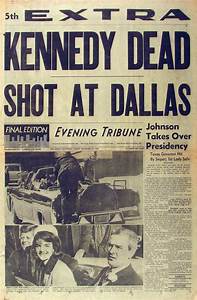
On Friday, November 22, 1963, President John F. Kennedy was assassinated in Dallas, Texas while riding in a motorcade. The country was plunged into grief and turmoil as people grappled with the reality of the tragedy and the painful loss of the nation's president.  Everyone who was of reasoning age on that date remembers exactly where they were and what they were doing when they heard news of the tragedy.  On this, the 60th anniversary of the untimely passing of President Kennedy, we pause to remember him, and that painful day. Margaret Sizemore Clark, Gil Tisnado, and Mike Bragg share memories of that day, and how it impacted them.  
Margaret Sizemore Clark
    For those of us old enough to remember this date, it was one that would forever change our world.
    I was 9 years old on this date.  I went to school just like I did any other day…except it was not to be like any other day.  We were out at recess playing kickball when the bell rang and my teacher, Miss Kerr, came to the playground to get us.  I don’t remember her being upset and I don’t remember how she broke the news to us, but I remember the effect of that news.
    The previous June President Kennedy had come to our town, China Lake, CA and the Naval Ordinance Test Station.  “The Base” as we called it, was home to a laboratory and testing facility for the Navy and was chiefly tasked with developing new weapons.  Their most recent accomplishment, the Sidewinder missile, was a major development, and as Commander-in-Chief, President Kennedy decided to come to the base for a demonstration of the missile’s capabilities.  As you can imagine, the news that the President of the United States was coming to the base was unimaginably exciting!
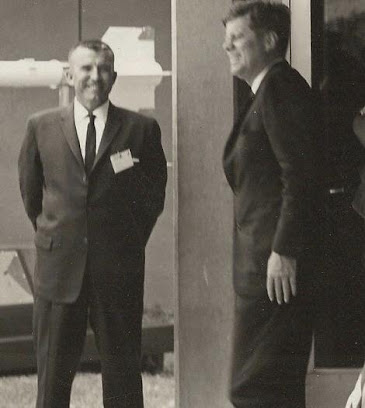
    The day of the President’s visit his jet, Air Force One, landed on the tarmac at the Naval Air Facility.  Bleachers had been erected to hold the dignitaries and the crowds that planned to attend.  I can remember being part of the throng that had gathered near the laboratory, where my father’s office was located.  It was a sea of people, but the President got out of his limousine and walked along the edges of the crowd shaking hands and nodding and smiling.  After he toured the lab, he exited out the main entrance, directly in front of where my father was standing before a replica of the Sidewinder missile.  It was an incredible day.
    On November 22 of that year, we all heard the news that President Kennedy had been assassinated.  We went home from school to watch the repeat of the tape that recorded the fateful drive through Dealey Plaza; we witnessed the sheer panic and confusion of the onlookers as the shots rang out. We saw Mrs. Kennedy’s reaction to her husband’s injury, and her blood-stained suit.  The network played the scene over and over and every time it ended with Walter Cronkite’s announcement, “President Kennedy died at 1 PM Central Standard Time”.  Throughout the afternoon we were glued to our TV set, being updated with what was happening in Dallas.  What stands out in my mind was the arrival of the ambulance that carried the President’s body pulling up to Air Force One.  The casket was put on a scissor-like apparatus and lifted to the cargo hold.  That made it real.  There was no mistake.  Death is something kids don’t usually encounter, but there it was in all its horrible reality, and it was scary.  We had just seen the President alive, smiling, shaking some of our hands not six months ago!  How could this have happened?  Mom and Dad watched with us, but no one said anything.  Nothing could make the confusion, shock, and sadness go away.
    The next few days were surreal: we watched as Jack Ruby murdered Lee Harvey Oswald on live TV.  We watched the funeral and then the funeral procession, hearing drums beat a solitary cadence. The Kennedy family and other dignitaries walked those long blocks to Arlington Cemetery.  The horses’ hooves clip-clopped but the saddle carried no rider, just a pair of boots placed backwards  in the stirrups.  No one said a word. The world changed forever for me that day; Unfortunately, it was just the first of so many things I would have to adjust to and try to make sense of. For my generation, that single event robbed us of our innocence, and opened our eyes to the real world.  It was not the safe world we had lived in just days ago. 
My father watching President Kennedy pass by. 
A couple of men in suits

Description automatically generated

Gil Tisnado
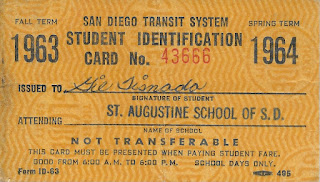
Everyone from my generation remembers exactly where he or she was when John Kennedy was shot. I was attending St. Augustine School in San Diego. It was during my ninth grade English class with Father Wasco that it was announced over the loud speaker that the President was shot. We were told to report to the gym for a special Mass. During Mass, the priest indicated that Kennedy had died, and even though it was mid-morning, we were dismissed immediately. We were instructed to go home to pray for him and for our nation.


The bus ride on bustling University Avenue was about six miles. It was a warm fall day and all the bus windows were open. I remember seeing adults on the sidewalks outside storefronts openly crying. I knew it had to be really serious if the adults were crying.

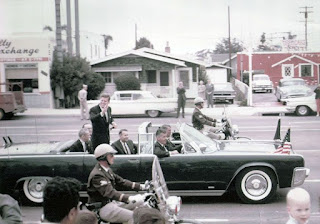
    It just didn’t make any sense to me. After all, JFK was just in San Diego the previous June. As thousands cheered, he rode in an open motorcade from the airport along El Cajon Blvd. to San Diego State to give the commencement address. Since my junior high school was nearby, a school buddy and I walked to San Diego State, snuck in without a ticket, and sat on the ice plant embankment in Aztec Bowl to hear our young president speak. But that was June, and now it was November.

Like many families, we were glued to the TV trying to make sense out of this tragedy. However, at some point, my mom had enough, “That’s it! No more TV. Pack some things. We’re going to Palm Springs.”

    So my mom, my stepdad and I loaded up our car and headed off to Palm Springs. I swam alone endlessly in the motel pool, enjoying my Palm Springs weekend. Although the escape from real-world violence was temporary, since while driving home we heard the news that Jack Ruby had killed JFK’s assassin, Lee Harvey Oswald. Once home, we would return to being glued to our small black and white TV, and continue to mourn with the rest of the nation.


Mike Bragg
    I was 10 years old, attending the fourth grade class at Buchanan Street Elementary School, enjoying a Friday lunch hour and playground time. The usual Los Angeles smog had blown away from the Santa Ana “Devil Winds” the night before.
    Sitting at a lunch bench, I thought about the next week’s Thanksgiving feast and yearly family get together as my teacher, Mrs. Hegney ran out of the building and on to the lunch yard. She clasped at a tissue when not dabbling it at her red, tearful eyes.
“The president has been shocked…The president has been shocked!!!" I was confused at first, having never seen Mrs. Hegney, or for that matter, any other adult crying..I thought, “What does she mean, the president has been shocked…how could he get SHOCKED?
    I remember other classmates, leaving lunch tables, or running from the playground to gather around Mrs. Hegney to hear what was going on. During that time, our school principal stood at the door to the main hallway, her hands covering her eyes as she shrieked, “SOMEONE SHOT PRESIDENT KENNEDY IN THE HEAD!!!”
    Our teacher quickly lead our group of confused or crying 10 year olds back to our classroom, where a school TV on a steel cart flickered in black and white across classroom walls and window blinds…live news coverage switching back and forth between Dallas Texas and New York.

     For most 10-year-old fourth graders as myself, it was difficult comprehend what TV and radio broadcast was reporting.  Arriving home from school a couple of hours later, my brothers and I walked in the door where my mom was closely focused on the screen of our television set, watching Walter Cronkite describe the chaos of Dallas that afternoon.

    Once I felt the safety of being home from school a few hours later, the reality that President John F. Kennedy had been assassinated became very real to me. Sixty years later, just as vivid, were the days following the Friday afternoon TV news bulletins and reports from across America and the world. The movie theaters in our neighborhood were unlighted and closed. Los Angeles Top 40 radio stations suspended regular music, and broadcast classical music throughout the weekend.

     On the Sunday morning after the assassination of President John F. Kennedy, my mom made pancakes as my dad and I watched live coverage of the transfer from jail of Lee Harvey Oswald in Dallas, Texas. With the shock of Friday’s tragedy still blurred but nonetheless fresh, Dad and I watched in real time as the alleged assassin of JFK was, himself, killed by a gunman in Dallas. 
    As with most American families, our Thanksgiving 1963 was a sad and solemn day.

Thursday, November 2, 2023

How Monday Night Football Transformed Pop Culture

By Rev Protodeacon George A. Haloulakos

Baby Boomers have borne witness to the transformational impact of Monday Night Football (MNF) on Pop Culture.  Believe it or not, MNF was introduced more than 50 years ago (1970) while forever altering mass market TV viewing habits and transforming Pop Culture.  At a time when people spent their evenings watching variety shows, sitcoms, westerns and game shows on a small handful of network TV channels, MNF immediately altered viewer preferences with a then outsized entertainment model that not only crossed from the sports venue into Pop Culture, but created a significantly larger audience that went well beyond the traditional male sports fan who watched NFL football on Sundays.

Here is a sample list of the long lasting impact created by MNF:
> Monday Night Football was aired by ABC, a perennially 3rd ranked national network (behind CBS and NBC) at a time when there were just three national TV networks.  With the newly merged league (the NFL and AFL were now combined under an expanded "NFL" business model) this was a great platform to showcase the expanded offerings among a larger geographic region.  By the end of the 1970s, ABC became the top-rated network as its fortunes paralleled the NFL becoming the nation's number one spectator sport.

> MNF essentially created the voluble, celebrity broadcaster role that is now de rigueur in all sports broadcasting venues.  Howard Cosell was selected for this job.  As the third man in the broadcast booth, Cosell provided a complementary if not entertaining fit to the rather staid, traditional two-person announcing duo format.  Hall of Fame football star Frank Gifford provided the standard play-by-play narration with former NFL quarterback Don Meredith in the analyst role.  In short order, Cosell's bigger than life persona became equally important to the overall entertainment package.  While Gifford adhered to a restrained, serious broadcasting style his analyst partner Meredith provided humorous anecdotes and even sang "the party is over" when the outcome of the game was no longer in doubt.  On a more serious note, Cosell actually created a template that is followed to this day with his 3-minute summary of all the NFL highlights from the Sunday games.  These halftime highlights became a huge drawing card to both the serious and casual fans alike.  While MNF had various high-profile broadcast trios, the Cosell-Gifford-Meredith group is the one that is best remembered.

> With the passage of time, it became commonplace for the broadcast booth to have major TV & motion picture stars along with famous musicians visit and provide guest commentary.  MNF used twice the number of cameras usually employed for broadcasting an NFL game, and use of flashier graphics plus a widely recognizable musical theme to immediately signal the television viewing audience that they were being treated to a big-time special event.  Instant replay was more frequently used to diagram the action, which, in turn, created ongoing discussion and debate among the broadcast crew about what actually happened.  With more camera angles versus the Sunday games shown on CBS and NBC, the ABC viewing audience was able to experience gridiron action up close and personal, with a "you are there" feeling.

> MNF introduced the sideline interview.  Cosell interviewed quarterback Fran Tarkenton before the start of the game, and this was the first time an active player was interviewed live on the field before or during a game.  This has also become a standard practice.

> MNF became the weekly topic of conversation on Tuesday mornings in schoolyards and offices across the nation.  It became a must-view weekly event in which Monday nights were an occasion for working parents to try to arrive home earlier and prepare dinner beforehand while students would scramble to finish their homework ahead of kickoff.  When the MNF film crew would arrive in a new destination each week, it was the impetus to have special banners, billboards and posters all over the city thereby fueling even greater excitement and anticipation.

Are there any special memories that any of you in our GNN audience have regarding Monday Night Football?  I have two favorite MNF memories.  First, is when Howard Cosell interviewed Joy Piccolo (widow of Chicago Bear running back Brian Piccolo) at halftime in anticipation of ABC's Made For TV Film "Brian's Song" which paid tribute to Piccolo with emphasis on his groundbreaking friendship with teammate Gale Sayers as well as his heroic battle against cancer.  The second occurred at the end of a broadcast in which the hometown team was on the losing end of a one-sided contest.  While Gifford was seriously engaged with calling the on-field action, Cosell and Meredith were bantering back and forth as the camera crew zeroed in on a disgruntled fan who promptly saluted the nationwide TV audience by extending his middle finger.  Without missing a beat, Meredith humorously observed that the fan was telling the ABC broadcast trio they were number one!

In the intervening years, much of what has been described here may seem as commonplace BUT this affirms the transformational power of Monday Night Football.  It not only broadened the viewing audience while creating a more enjoyable viewing experience, but it helped make sporting events into the reason for hosting private parties at home or in restaurants bringing families, friends and work-related colleagues together.  This has created shared memories across various demographics and generations, something we can all appreciate.